
Peak Oil - continued
Transition Initiative members are trying to trying to help themselves and others to understand how deeply their world will change as fossil fuels become ever more expensive. We work to develop the people’s ability to withstand these changes and live fulfilling lives in an era of less energy. The remainder of this section deals with the reality of peak oil and the interaction between energy and finance.
Transition Initiative members are trying to trying to help themselves and others to understand how deeply their world will change as fossil fuels become ever more expensive. We work to develop the people’s ability to withstand these changes and live fulfilling lives in an era of less energy. The remainder of this section deals with the reality of peak oil and the interaction between energy and finance.
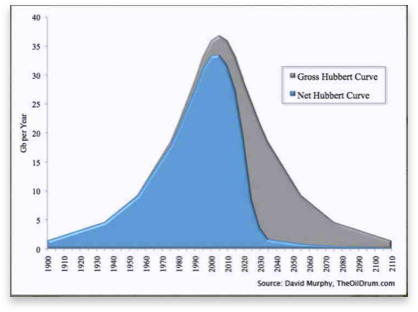
For those here who may be unaware of the idea of peak oil, the point is that global oil production appears to have reached a production peak that it will not be physically possible to exceed. Oil discoveries peaked decades ago and we have since been increasing production from large existing fields using ever more complicated and expensive technology, in order to supply increasing global demand from decreasing reserves.
The production peak does not mean that oil is imminently running out - in fact there is probably half of all the oil that ever existed still in the ground, but it is the expensive and relatively inaccessible half. Notice in the graph, the blue area is the NET energy, once the energy used to produce has been subtracted. As oil becomes more inaccessible, notice how quickly the NET energy drops.
We can no longer increase production and production will fall over time as we continue to use up reserves which are not being replaced by new discoveries. Although discoveries continue to be made, they are few and far between, and of much smaller size than the giant fields we have relied on for so long. As they are much more challenging to produce, they rely on high oil prices in order to remain commercially viable.
Does the Price Only Move Up?
One might imagine that as an essential resource becomes scarcer, it's price would move in one direction only - up - and for a while it appeared that would be the case. However, our energy supply system is set in the context of our existing economic and financial structures. The extreme and increasing stress that these structures are under will interact with future energy scarcity with devastating effect, effectively placing a hard limit on any eventual recovery. Energy is the master resource without which no activity, economic or otherwise, is possible.
The effect of easy credit was to flood commodity exchanges with liquidity, as liquidity fleeing risky securitized assets searched for a safe haven. This pushed up the prices of all commodities beyond what could be justified, sending premature signals of scarcity that attracted even more speculative investment. In this way a bubble was formed, but bubbles always burst, and when they do, the speculative money disappears very quickly, taking price support with it. The price collapse we have seen since is partly a result of speculation in reverse, as speculators go short, and partly a result of falling demand, and that fall in demand has only just begun.
Viability of Energy Alternatives
The consequence of that price plunge is a severe impact on the viability of continued fossil fuel exploration and development, and also a similarly significant impact on the viability of energy alternatives such as renewables and efficiency investments. Each time alternatives appear to be reaching the threshold of viability, the combination of the price of conventional energy and the cost structure for the alternative is such that the threshold is never quite reached. Once again, energy prices are falling as costs for alternative have remained high, so that the hoped for developments may again be put on hold.
We are seeing the beginning of a global demand collapse, as the credit crunch takes an ever increasing toll on global economic activity and international trade. Consumers in developed countries are tapped out and trying to repair their tattered balance sheets by cutting back, as are companies and banks. Consumption is therefore falling, which will hit exporting economies very hard indeed. They have spent vast sums, and used huge amounts of raw materials, to build what will now be shown to be an enormous excess of productive capacity. Their demand for raw materials may not recover soon, as there will be relatively little demand for their products.
Collapse in Demand for Oil
For the time being, the on-going demand collapse is causing the price of commodities, and particularly energy, to drop. This may well continue for a period of time, but the danger is that the demand collapse will lead to a supply collapse, and at that point prices will find a floor and begin to climb again. This price bottom could happen earlier than would be the case for other goods and services.
Exactly when we might see the impact on supply is not clear. Already there are many projects with high cost structures which are no longer viable. These are the projects that could have cushioned the down slope of Hubbert's curve (the decline from peak production of oil), but will not now come on line. Although they could in theory be developed at a later date, increasing capital constraints will make financing almost impossible, hence development will be unlikely for a very long time. We will therefore continue to make do with the fields already in production, but many of those are depleting very quickly - Ghawar in Saudi Arabia, Cantarell in Mexico, Burgan in Kuwait and many others.
For a while it will be enough to sustain the much lower level of economic activity that appears to be in the future, but not for all that much longer, especially since there will be many other 'above ground factors' to consider. For instance, production infrastructure requires expensive maintenance that will be increasingly difficult to perform, separatist movements in producing countries will seek to control resources for their own benefit, productive capacity being fought over will be damaged or destroyed, sabotage by the disaffected with nothing left to lose will increasingly become a factor, and piracy will make delivery much more challenging. Living off our fossil fuel legacy will therefore become progressively more difficult.
Alternative Government Responses to Peak Oil
Many governments around the world, including those of all the major powers, are well aware of peak oil. In a very real sense in a modern world, oil IS power, as there is no comparable source of concentrated, transportable and flexible fuel. Securing access to it is therefore of the utmost strategic importance. Some governments, like the Anglo-Saxon economies, have so far appeared to place their trust in the global markets and their own perceived ability to outbid the competition. Others, notably China, have been quietly arranging long term bilateral supply contracts directly with producers, thereby taking production off the market.
China's strategy is likely to prove far superior in difficult times when international trade is drying up and no one can be sure of being able to outbid the competition. By the time others realize that trusting the market to provide, they may have been completely out maneuvered. This will be the foundation of the coming shift in hegemonic power towards the Far East, but it may not be a peaceful transition. Resource wars become more likely under these circumstances.
Adapted from The Automatic Earth blog, December 2008, Nicole Foss